Global supply chain strategy, redefined

Your supply chain is a valuation decision.
It is just not being treated like one.

Most companies optimize for cost. We design supply chains that drive margin expansion, risk diversification, speed to market, and valuation lift.

The Real Problem

Good decisions. Wrong lens.

Supply chain decisions are made operationally. Their consequences are financial.

Procurement negotiates cost. Operations manages output. Finance measures results. Individually, each function is doing its job. Collectively, no one is connecting them. Because almost no one is asking the question that actually matters: does this decision increase what this business is worth?

The pattern we see

Inside most growth stage manufacturers, the same conversations keep happening. Across the table, across departments, across quarters.

Head of Supply Chain

We are reducing unit costs.

CFO

Then why are margins still compressing?

Procurement

We have secured reliable suppliers.

COO

Then why are we still exposed to a single point of failure?

Operations

Lead times are under control.

CEO

Then why are we still losing speed to market?

Operations Team

The system is scaling with the business.

Board

Then why is valuation not moving?

The team is not wrong. The lens is. Every sourcing decision. Every production shift. Every logistics tradeoff. Each one is showing up in your EBITDA and in your valuation multiple. Just not by design. This is not an operations problem. It is a value architecture problem.

The wrong question

"Where should we manufacture?"

The question we reframe

"How should our supply chain be designed to maximize what this business is worth?"

What We Do Differently

We align what others leave disconnected

Most companies do not have a supply chain problem. They have an alignment problem.

Procurement is optimizing cost. Operations is optimizing output. Finance is measuring results. Leadership is focused on growth and valuation. Each function is doing its job. But no one is designing how those decisions connect.

We become the missing layer. Emerald Axis Partners sits across these functions, not inside one of them. We connect supply chain decisions to margin outcomes. Sourcing strategy to risk exposure. Production models to speed to market. Operational structure to valuation. In real time. Not after the fact.

We translate across the room. The Head of Supply Chain understands how decisions impact EBITDA. The CFO sees how operational structure is driving or eroding margin. The COO understands where risk is structurally embedded. The CEO and Board see a system designed for scale and transferability. Without that translation, good decisions stay isolated. Enterprise value never compounds.

We design the system. Not just improve it. We do not optimize individual decisions. We redesign the system those decisions sit inside.

Supply chains built for margin, not just cost. Networks designed to distribute risk, not concentrate it. Structures that increase speed without increasing fragility. Operations that scale beyond the founder, and stand up to diligence.

Methodology

The Emerald Axis Value Creation Cycle

A structured system for transforming supply chains into enterprise value engines.

Emerald Axis Value Creation Cycle methodology diagram01DIAGNOSE• Assess current state• Identify risks &opportunities• Quantify value gap02DESIGN• Define strategicobjectives• Architect optimalsupply chain• Build executionroadmap03EXECUTE• Activate partners& resources• Implement &transition• Deliver results04OPTIMIZE• Improve performance• Leverage AI & data• Drive efficiency& resilience05VALUECREATION• Increase margins• Reduce risk• Enhance enterprisevalue• Capture equityupsideMORE DEAL FLOW• Stronger network• Proven outcomes• Greater credibility• Higher quality opportunities
Where Value Comes From

Four ways we build what your business is worth

Enterprise value is the compounding result of decisions made across four levers. Most companies pull on one. We architect all four to move together.

Margin Expansion. Redesign cost structures at the system level. Not through temporary cuts. Real margin sits structurally between procurement, production, and logistics. Nobody owns it because it does not live inside any single function. We do.

Risk Diversification. Reduce dependency across suppliers, geographies, and channels. Concentration is invisible until it is not. Every growth stage manufacturer is carrying risk they have never priced. We map it, price it, then redesign the system so the risk that remains is intentional, not accidental.

Speed to Market. Increase responsiveness without sacrificing cost discipline. Lead time is not a logistics metric. It is a revenue lever and a working capital lever. We compress it without trading away the discipline you have already built.

Exit Readiness and Valuation Lift. Position your operations to be scalable, transferable, and buyer ready. Margin, risk, and speed are inputs. Enterprise value is the output. When the work is done right, the multiple reflects the actual value of the business, not the founder's heroics. The buyer prices what is transferable.

Four levers. One destination. What this business is worth.

Orchestration

We do not just design the system. We build it.

We orchestrate execution across borders. This is not theoretical strategy. We operate as the orchestrator across:

Economic zones and incentive structures. Vetted manufacturing partners. Transition execution and implementation. Financial structuring and capital alignment.

A curated, trusted pathway. Not fragmented sourcing.

Most firms hand you a strategy. We build the bridge.

Who We Serve

Built for operators who think in enterprise value

Not every manufacturer is our client. Only the ones building for what is next.

We partner with U.S. manufacturers in the $10M to $150M range. Founder led, operator led, or private equity backed. Most have a forcing function. Tariff exposure, dependency on China or a single region Asia supply base, margin pressure, or a transaction on the horizon.

But the structural fit is not what makes someone a client. The mindset is.

If you understand that supply chain architecture impacts EBITDA and valuation,

if you are facing growth, risk, or a capital event that demands more than incremental fixes,

if you have the capital and conviction to execute structural change,

if you are building for what this business is worth, not just what it costs to run,

then we should talk.

If you are optimizing for cost, we are not the right partner.
If you are optimizing for value, you already know.
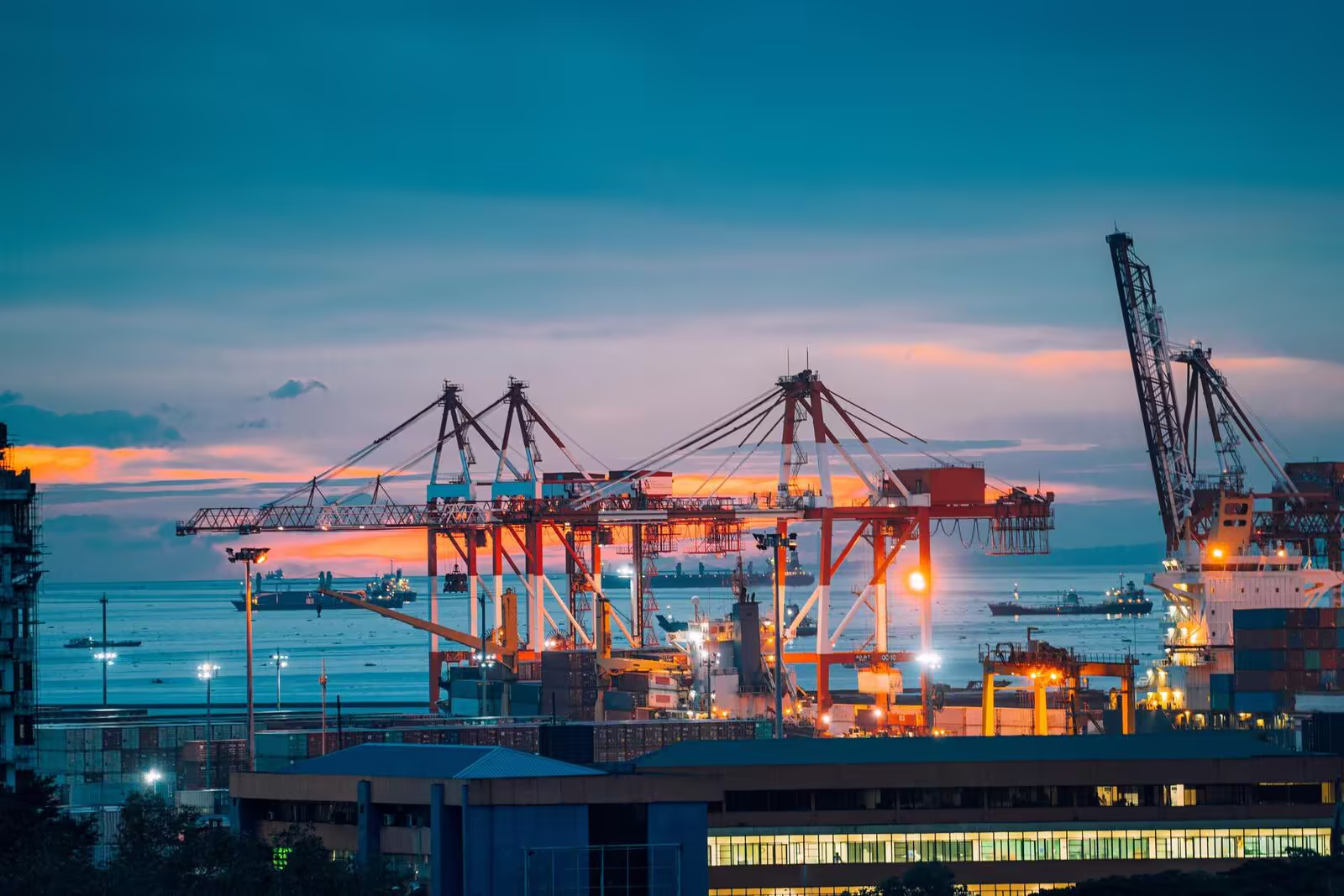
What This Looks Like in Practice

Operations that compound into enterprise value

When the system aligns, the results are not abstract. They show up in the numbers that drive what this business is ultimately worth.

Clients typically achieve:

Improved gross margins through structural redesign, not temporary cost cuts.

Reduced concentration risk across suppliers, regions, and channels.

Faster production and delivery cycles without sacrificing cost discipline.

Increased operational visibility and control across the system.

Stronger positioning for capital events, transactions, or exit.

The specifics depend on where you are. The architecture gets specific to your business.

How We Work

Shoulder to shoulder.

Phase 1

Diagnostic & Value Mapping

Assess your current system through financial and operational lenses.

Phase 2

Architecture Design

Rebuild your supply chain to align with enterprise value drivers.

Phase 3

Implementation & Optimization

Execute alongside your team and continuously refine.

This is not theoretical consulting.
We work shoulder-to-shoulder with leadership teams.

A Conversation

Your supply chain is already impacting your valuation.

The question is whether it is increasing it or limiting it.

Most firms advise.
Most operators execute.
We architect the alignment others leave to chance —
so every decision moves the business in the same direction.
When the system aligns – everything compounds.